Board index » Talking About Stuff » Suzuki Talk
 
|
Page 1 of 1
|
[ 17 posts ] |
|
Print view
Previous topic | Next topic
| Author |
Message |
seanzook06


Joined: Wed Oct 06, 2021 6:13 pm Posts: 96
Vehicle: 1993 sj70 soft top

|
 Posted: Thu Sep 01, 2022 6:04 pm |
|
the time is coming soon for me to build rear shock mounts for the sierra. I am running 225/75/16 tyres on -13 rims with my suspension setup I have roughly 800mm of articulation, most of which is droop due to no lifting the car, and the inboarded and spaced bumpstops the shocks I am using are a bilstein 5125, 170/60 valving with 8.4 inches of travel. from the looks of it they are slightly to short, but I am not changing them, because I ordered them from the US and dont want to wait ages for returns and finding a different length, the next sie up in the valving I want is also a 12 inch travel shock, too big for my needs. ideally I want to run the lower shock mount as close to the bumpstops as possible, in order for most of the shocks length be used in droop. the issues I am facing have to do with shock length - the shocks will become the limiting factor in my articulation and I dont want that. the physical size of the shock is another issue - the body is quite wide and if I mount it outboard of the chassis then there is significant tyre rubbing on the shock. to mount it just inboard of the chassis I will have to cut a hole in the floor and lose use of the rear seats, something I would prefer not to lose. I also dont want to run hektik angles on my shocks either. I dont want to run body lift, I want to keep the car low. so in summary I need some help on how to work with shocks which are too short and not have them be the limiting factor in articulation, and on how to package the shocks in the least intrusive way possible. for any more info on what I have done with the suspension, see my build thread viewtopic.php?f=4&t=57308thanks, sean
|
|
|
|
|
Zook_Fan
az supporter

Joined: Thu Mar 13, 2008 10:30 pm Posts: 4530 Location: Toowoomba
Vehicle: Maruti and LJ80's
|
Posted: Fri Sep 02, 2022 6:52 am |
|
|
I'm not going to be much help regarding how and where to mount them, but I'll put some context around the dampener length and travel.
When you measure articulation you are measuring the combined travel of the springs on both sides of the car. Assuming they are flexing equally (they're not quite but it's not super relevant) your 800mm total articulation is 15.75 inches travel for each wheel as measured I assume at the hub?
Problem being, your dampener don't mount to your hub, the bottom mount is inboard of the leaf spring and the top mount even further in to that. The lever ratio then dictates what proportion of the wheel travel the dampener will see.
If I were mounting them I'd get the car as articulated as possible, put the bottom mount of the dampener in the stock position, compress the dampener and look at the mounting locations for the top by swinging the dampener through the range available in the arc. You'll have to find a compromise between the angle and the total travel you want, more angle = more travel but also = less dampening. Limited controlled articulation with a good dampener is better than heaps of uncontrolled articulation.
|
|
|
|
|
seanzook06
Joined: Wed Oct 06, 2021 6:13 pm Posts: 96
Vehicle: 1993 sj70 soft top
|
Posted: Fri Sep 02, 2022 2:26 pm |
|
|
Thanks zook fan for the reply. I have measured it up and neither of the stock shock mounts will work for me. They are both too low. If I use the stock upper mount then the body of the shock will hit the housing on compression. To counter this I will need the shock mount on top of the housing. And a raised upper shock mount. Because of the inboarded springs, the stock lower mount makes the shock in a much more upright position, able to use less travel for the length of the shock. The advice I am looking for more has to do with non standard applications and custom setups.
Thanks sean
|
|
|
|
|
Gwagensteve

Joined: Thu Feb 26, 2009 10:30 pm Posts: 12997 Location: Melbourne
|
Posted: Fri Sep 02, 2022 6:37 pm |
|
|
Articulation comes into play the closer the shock is to the wheel/outboard of the spring. If the shock is inside the spring shock travel only has to match spring travel. Slight shock inclination assists to stabilise the car through body roll, but excessive inclination is counterproductive - the shock becomes less effective and at it's worst, the shocks basically don't function at all when the car is articulating making the car unstable.
You've dramatically lowered rear roll stiffness but bringing the springs in so far.
How much too short are the shocks you have now? I'd be surprised if your springs have more than 200mm of vertical travel in them.
|
|
|
|
|
seanzook06
Joined: Wed Oct 06, 2021 6:13 pm Posts: 96
Vehicle: 1993 sj70 soft top
|
Posted: Sat Sep 03, 2022 10:35 am |
|
|
With spaced bumpstops my springs have roughly 240mm of travel in them.
When mounted straight and just outboard of the chassis my shocks are too short by roughly 80mm
|
|
|
|
|
Gwagensteve
Joined: Thu Feb 26, 2009 10:30 pm Posts: 12997 Location: Melbourne
|
Posted: Sat Sep 03, 2022 4:22 pm |
|
|
There isn't room for shocks outside the chassis, especially when the shocks are straight up and down - the chassis too wide.
copying the shock location used in a Range Rover/Discovery/Defender, Gwagen, (or even a vitara) will help with clearance and make the length work but those cars all run a much narrower chassis relative to their track width when compared to a Sierra. I know how hard outboard shocks are to achieve even with a small body shock like a Bilstein - I certainly couldn't make it work.
The bigger issue with your current set up is nobody reverses up obstacles. You'll (now) need to add rear roll stiffness to make the front suspension work when the car is negotiating obstacles when driving forwards.
|
|
|
|
|
seanzook06
Joined: Wed Oct 06, 2021 6:13 pm Posts: 96
Vehicle: 1993 sj70 soft top
|
Posted: Sat Sep 03, 2022 4:23 pm |
|
here is a picture to try and further explain. my diff isnt in at the moment but I have a couple of peices of steel to represent the thickness of the housing. 
|
|
|
|
|
seanzook06
Joined: Wed Oct 06, 2021 6:13 pm Posts: 96
Vehicle: 1993 sj70 soft top
|
Posted: Sat Sep 03, 2022 4:28 pm |
|
|
sorry, I didnt see your reply before posting the above picture. I will be modifying the front suspension in order to lower the roll stiffness to make the front work harder. I am simply doing one end of the car at a time, the car wont see any offroad driving in between modifying the front and rear suspension. I will take a look at the shock mount setups on some of the vehicles you mentioned.
|
|
|
|
|
Gwagensteve
Joined: Thu Feb 26, 2009 10:30 pm Posts: 12997 Location: Melbourne
|
Posted: Sat Sep 03, 2022 5:24 pm |
|
Your photo's aren't working. The issue is you can't (and don't want to) lower the front roll stiffness as much as you have lowered the rear - the car won't be drivable - body roll will be out of control. You can bring the front springs under the chassis, and that's functionally about it - so ~40mm per side. If you add a torsion bar rear swaybar you can tune rear roll stiffness to work with the front, but you have to trust me that you've taken rear roll stiffness too low and the car will be spooky when climbing, like a coil patrol or 80 series. Shocks don't influence roll stiffness, they only slow the effect. *Please note, I'm not questioning you can get your car to 800mm of articulation. I'm questioning how functional it is when it's able to do that* It's very impressive if you can get your car to articulate 800mm and feel stable at that - that's enormously difficult to do in a SWB Sierra with fairly standard track width. My reference box for assessing balance and articulation is 700mm. The leaf sprung SWB sierras I've built don't really feel that great at 700mm of articulation, but that's always driven nose up, not nose down, to mimic the car on an obstacle. In fact, I was looking for some photos of cars on my 70mm box, and here's an interesting one. This is DOOF and CJ's old car on the box from a billion years ago.  These cars both run OME RUF, and N76 shocks (about 11.5" travel) CJ's car is about 6" over stock LWB wheelbase and runs rear leaves which are 10" longer than stock. Both cars run standard NT spring spacing underslung the chassis. CJ's car did not have an engine and gearbox in it. BOTH cars had to be tied down to the box to stop them unloading. Leaf cars just want to start to straighten then suspension up in this situation, which makes them feel unstable and spooky. Like I said, I'm not doubting your car can do it, but before you spend more time on it, put a front wheel 800mm up in the air and then see what happens. This is an exaggeration, but it's going to be something like this:  that is the front stops working because the rear has lower roll stiffness and the front won't work until the back is completely out of travel. However, if, by the time the rear is out of travel the body is on a really big angle (which happens because the front isn't working) then the centre of gravity stays high in the front and it starts to roll the front of the car over, exacerbating the problem. Roll stiffness is far more important than total travel. In my opinion, slightly lower front roll stiffness than rear, and fairly even articulation front to rear results in the most trustworthy car to drive off road. Here's three photos that really highlight this in practice. Here's my car when it was radius arm rear, leaf front. Commodore front shocks and 1" over stock shackles, stock front leaves. In this photo I unbolted one rear radius arm bolt. This has no effect on spring rate, shock function or geometry, it simply drops rear roll stiffness very low. Only the springs control roll stiffness in this configuration. This on a little culvert our the front of my place.  Note the angle the body is on, which is dramatic, and also note the clearance between the front tyre and the guard. If we go all GQ patrol/teal slack* mode, (i.e reversed up the obstacle, look what I could make the car do when it was setup like this:  OMGWTFBBQ Unfortunately it was basically impossible to drive uphill like this. Just awful. Now compare it to this with the rear roll stiffness reinstated. (all bolts back in)  It doesn't look hektik at all but the body is nice and level and look how hard the front suspension is working compared to the photo up above. *Outers is back(!)
|
|
|
|
|
sideways
az supporter

Joined: Fri Oct 29, 2010 1:53 pm Posts: 5933 Location: Northcliffe, W.A.
Vehicle: LJs, Sierra, Jimny, Swift.
|
Posted: Sat Sep 03, 2022 8:55 pm |
|
Gwagensteve wrote: It's worth noting this exact car came spectacularly unstuck thanks to it's terrible suspension balance/design. It's pretty much worst case scenario with a complete lack of rear roll stiffness, massive rear travel, high sprung COG relative to rear roll centre and a very stiff front end. https://www.youtube.com/watch?v=73ljDXHMRm8
|
|
|
|
|
Gwagensteve
Joined: Thu Feb 26, 2009 10:30 pm Posts: 12997 Location: Melbourne
|
Posted: Sun Sep 04, 2022 12:11 pm |
|
Yeah. It's hard to imagine a worse combination. It's interesting to see how far Tuff Truck cars have come from back in the day where they nearly all seems to have terrible suspension behaviour under power/off camber to now where they are mostly incredibly stable and predictable. (certainly in the upper level of the competition) Many many years ago (mid 90's maybe?) US 4WD journalist/writer Jim Allen put together a comparison test of various Land Rover defender suspension packages. From memory, the University of Utah (or similar) was involved in developing the testing program. I can no longer find the article, it used to be available on line. In any case, it was the first time that anyone I'm aware of had tried to measure "balance" empirically and seek to correlate what make a car feel good off road to measurable parameters. One of the things they looked at was the percentage of flex that was being done by the front axle when a car was being ramped. All the systems that used the conventional Land Rover radius arm design (so, high front roll stiffness) pushed the majority of travel to the rear end, and some recovered slightly once the rear had run out of travel and then forced the front to flex. The clear winner in both off road feel, overall articulation and % of flex done by the front axle was the Safari Gard three link- it did something like 56% of the flex with the front axle when ramped. All the results were graphed out and you could see the effect of the 3 link keeping the car low on the ramp the balanced. I only have a couple of photos of this testing (like I said, it was basically pre internet) , but here you can see the dramatic difference between a car that's balanced:  and a car that's not:  The "extreme" Land Rover community is still completely smitten with putting over length rear shocks in the car and having the rear springs dislocate because it looks hektik or something. I think this is because most of the modified Land Rover products come out of the UK where they have no idea what 4WDing is. This kind of thing: 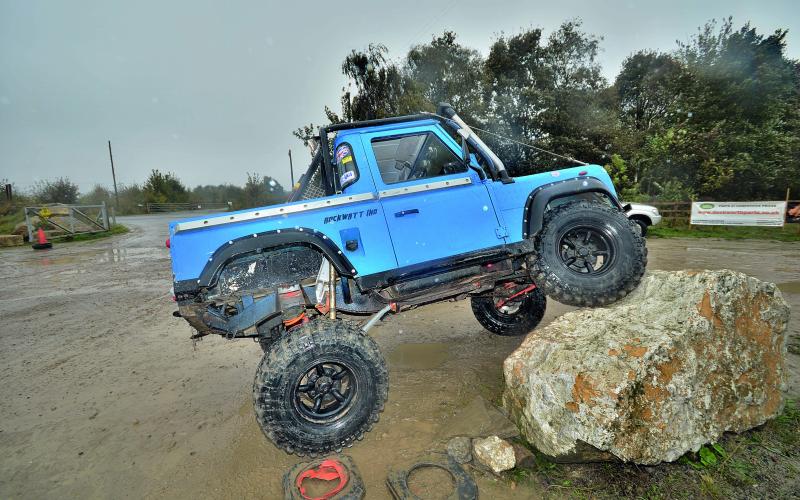 I use an angle finder on the front bumper and then on the front axle to work out the ratio between the angle the body is on and the angle the front axle is on. I repeat the test in reverse to see how balanced the car is. In my case the results are very similar, but I'd expect them to be. A leaf sprung Sierra will RUF will work the front harder than the rear when climbing and this is why RUF is so effective. The car fairly closely follows the angle of the rear axle and the front opens up, which keeps the car low on the obstacle and feeling stable.  Greg's CAPSIZE was one of the first cars I RUFed - WT spring spacing all round.   Greg's current car has NT spring spacing front and rear.  Jinxy had WT spring spacing in the rear and NT in the front. Rear shocks were just OME on stock mounts. and the trolley tug is WT spaced front and rear.  it's driving downhill in this photo, but you can still see the front is working way harder than the rear. a stock Sierra would follow the nose in this scenario. My point is all of these cars are super capable and confidence inspiring to drive, and none of them had any real effort spent to make the rear flex hard. Greg's black car, with inboarded bumps and the shackle hangers pulled forward is probably the one with the most time spent on it, and in all honesty it really doesn't make much difference, because as soon as the car is climbing the rear doesn't flex much. Remember too that the leaves are transmitting the torque to the ground. Derating springs and freeing the rear up starts to induce severe axle wrap which is just lost traction (and breaks unis) It's possible to build a very free suspension but it's hard to make it reliable and hard to make it nice to live with it you get on the throttle and the car starts to bounce and flop all over the place.   Josh's car did one Tour setup like this. It was super flexy but very, very floppy. It wrapped and unloaded like crazy. This is the sort of situation where you want the car to be very faithful and easy to read.  Anyway, this was a long and dense wy of saying don't sweat the rear and don't take rear roll stiffness too low. It won't make the car more capable, only less trustworthy.
|
|
|
|
|
Beery

Joined: Thu Mar 28, 2019 4:18 pm Posts: 331
Vehicle: suzuki sj50
|
Posted: Sun Sep 04, 2022 7:52 pm |
|
Gwagensteve wrote: These cars both run OME RUF, and N76 shocks (about 11.5" travel) CJ's car is about 6" over stock LWB wheelbase and runs rear leaves which are 10" longer than stock. Both cars run standard NT spring spacing underslung the chassis. CJ's car did not have an engine and gearbox in it. BOTH cars had to be tied down to the box to stop them unloading. Leaf cars just want to start to straighten then suspension up in this situation, which makes them feel unstable and spooky. I'm not sure if I'm missing something here, but What is it about a leaf car that makes it want to unload in situations like this, compared to a coil car? (Assuming both cars suspension setups are comparable in their own right - Balanced roll stiffness, similar travel etc..)
|
|
|
|
|
seanzook06
Joined: Wed Oct 06, 2021 6:13 pm Posts: 96
Vehicle: 1993 sj70 soft top
|
Posted: Mon Sep 05, 2022 7:13 am |
|
|
In response to gwagens posts, if I lower the front roll stiffness to that of the rear in order to get the front working, is the nordy roll just going to be a problem on road, or will it affect off road capability too? I prefer to crawl off road and would an increase in body roll affect that crawling capability?
If I put the front sway bar back on for road use combat the body roll enough that I don't need a rear sway bar.
I haven't flexed the front up yet, but I will this arvo and take pictures, I imagine it will be similar to the car above where the front end is doing nothing
|
|
|
|
|
seanzook06
Joined: Wed Oct 06, 2021 6:13 pm Posts: 96
Vehicle: 1993 sj70 soft top
|
Posted: Mon Sep 05, 2022 7:18 am |
|
|
Few mistakes in the above post. 'nordy roll' is supposed to be body roll.
Also it is supposed to say; if I put the front sway bar back on for road use, will it combat the body roll enough that I don't need a rear sway bar
|
|
|
|
|
Gwagensteve
Joined: Thu Feb 26, 2009 10:30 pm Posts: 12997 Location: Melbourne
|
Posted: Mon Sep 05, 2022 9:25 am |
|
|
The stock swaybar isn’t all that heavy, it won’t transform the handling but cars with high front roll stiffness and very low rear roll stiffness are nasty to drive. They understeer heavily and pick up the inside front wheel when cornering.
I do not believe in changing suspension settings between on and off road. If a car doesn’t handle on road it doesn’t handle off road. Yes, a car with very low front and rear roll stiffness will want to flop off road.
For a while when I was running a rear three link I had very low rear roll stiffness and moderate front roll stiffness. (Radius arm front). It also had a reasonably low rear roll centre, which you can see in the photos above- about level with the top of the axle tube. It drove on road as I described above- lots of body roll, understeer and picking up inside front tyres on cornering. Off road it was spooky on side angles for the same reason- it would flop over and lift front wheels.
Now I have closely matched roll stiffness front to rear, slightly higher in the rear, but I have a much higher rear roll centre than the front, which counters body roll. The car drives well on road and works very well off road.
With leaves you don’t have much control over roll centre. Even with a panhard rod you can’t make massive changes as you’ll bind the suspension up. Leaves have a reasonably low roll centre which is why softly suspended leaf cars body roll. Obviously lowering roll stiffness highlights this.
|
|
|
|
|
Gwagensteve
Joined: Thu Feb 26, 2009 10:30 pm Posts: 12997 Location: Melbourne
|
Posted: Mon Sep 05, 2022 12:35 pm |
|
Beery wrote: Gwagensteve wrote:
I'm not sure if I'm missing something here, but What is it about a leaf car that makes it want to unload in situations like this, compared to a coil car? (Assuming both cars suspension setups are comparable in their own right - Balanced roll stiffness, similar travel etc..)
Good question, and I don’t 100% have an answer. I reckon it might be that when articulated, a leaf spring is being twisted as well as compressed. It’s trying to fight both forces and retain it’s normal shape. When one corner of the car goes onto an obstacle and the weight transfers off the high side, the added force of the spring twisting is enough to uncompress the spring. In link/coil cars the spring only moves in one plane Radius arms are much the same. Once the weight is transferred off the high side the bushing bind becomes a significant factor and the suspension straightens up. Radius arms are also very influenced by drive torque as they have basically infinite antisquat. In my Gwagen (radius arm front and rear) I used to stall the converter up when I was on big angles to force the suspension to straighten up so I knew how bad the angle was going to get, then ease off the brake to move the car- this would make the suspension relax as the car moved and the car would settle through the obstacle.
|
|
|
|
|
seanzook06
Joined: Wed Oct 06, 2021 6:13 pm Posts: 96
Vehicle: 1993 sj70 soft top
|
Posted: Mon Sep 05, 2022 2:12 pm |
|
|
in terms of adding rear roll stiffness, would a solution be to add a leaf to the rear pack work to creating a harder sprung and stiffer rear end? the only issue for me with that is I dont want to add any height to my suspension
|
|
|
|
|
|
|
|
Page 1 of 1
|
[ 17 posts ] |
|
Who is online
Users browsing this forum: Google [Bot] and 91 guests
You cannot post new topics in this forum
You cannot reply to topics in this forum
You cannot edit your posts in this forum
You cannot delete your posts in this forum
You cannot post attachments in this forum
|
Untitled Document
Untitled Document
|




